Most teams think they know how to track competitors on social media because they follow the obvious company pages.
That catches launches, campaign copy, executive posts, and the occasional product tease. It misses the better signals: untagged Reddit threads, LinkedIn comments, GitHub complaints, Stack Overflow workarounds, Product Hunt reactions, Slack community chatter, and “alternative to competitor” questions where buyers are still deciding.
The useful job is not collecting screenshots.
The useful job is building a signal system that shows where competitors are winning attention, where customers are unhappy, and what your team should do next.
The fast answer: track competitors for signals, not screenshots#
To track competitors on social media well, set up a workflow around seven moves:
Pick competitors by revenue threat, not follower count.
Monitor company handles and executive accounts for launches, positioning, partnerships, and campaign rhythm.
Track untagged conversations across communities where buyers compare tools without tagging vendors.
Benchmark only metrics that change decisions: share of voice, engagement rate, top posts, sentiment, response time, content themes, and conversation quality.
Watch intent phrases like “alternative to,” “pricing,” “vs,” “switch from,” “recommend a tool,” and “does anyone use.”
Route signals to the owner who can act: sales, product marketing, product, support, comms, or demand generation.
Review weekly so the system gets sharper instead of noisier.
Standard social competitor analysis still matters. Audience growth, publishing cadence, top posts, engagement rates, and content formats give context for what your competitors are doing in public.
Use those metrics as the baseline, then add the harder layer: where buyers talk about competitors without tagging them.
But B2B SaaS teams need one more layer.
A competitor’s top LinkedIn post is useful. A Reddit thread where three buyers complain about that competitor’s onboarding and ask for alternatives is a GTM trigger.
How we built this playbook#
This guide is based on public competitive-intelligence and social-listening practices, current vendor/product materials, and B2B GTM workflow fit.
The evaluation lens is practical: what helps a SaaS team make a better move this week?
What to track before you pick a tool#
Start with the signal map. Tools only work after you decide what deserves attention.
At minimum, define:
Competitor tiers: direct competitors, indirect alternatives, “do nothing” replacements, and emerging players.
Sources: LinkedIn, X, Reddit, HN, GitHub, Stack Overflow, Product Hunt, Slack or Discord communities, niche forums, and review sites.
Keywords: exact brand names, misspellings, product names, category terms, feature phrases, pricing terms, and “alternative” phrases.
Owners: the person or team that will act on each type of signal.
Action rules: when to reply, when to create content, when to brief sales, and when to ignore.
Signal type | Example | Owner | Action |
Competitor launch | “New AI reporting beta from Acme” | Product marketing | Update battlecards, positioning notes and competitor campaigns |
Alternative search | “Best Acme alternative for a small RevOps team?” | Sales or founder | Join the conversation, give a useful answer and enrich the lead |
Pricing friction | “Acme became too expensive after adding more seats” | Demand gen + PMM | Create pricing comparison content and update sales messaging |
Product complaint | “Acme’s Slack integration keeps breaking” | Product + PMM | Log the issue, strengthen objection handling and review roadmap gaps |
Share-of-voice shift | Competitor dominates Reddit category discussions for two weeks | Marketing | Review community strategy, publishing cadence and response coverage |
The table keeps the system honest. If a metric or mention has no owner and no next action, it belongs in a report, not an alert.
Tactic 1: Build a competitor watchlist by revenue threat, not follower count#
Follower count is a weak starting point for B2B competitor tracking.
The competitor with the biggest audience is not always the one showing up in late-stage deals, stealing comparison searches, or shaping how buyers describe the problem. Build the watchlist around revenue risk.
Use four groups:
Direct competitors: same buyer, same budget, same job to be done.
Indirect alternatives: different product category, same outcome. A spreadsheet, agency, internal workflow, or broader platform can belong here.
Attention competitors: brands that win the conversations your buyers read, even if they rarely appear in your CRM.
Emerging players: small teams with sharp messaging, active founders, new Product Hunt launches, or fast community traction.
For a B2B SaaS company selling customer onboarding software, the watchlist should not stop at other onboarding tools. It should include adjacent platforms, agencies, internal workflows, and founders who own the onboarding conversation on LinkedIn.
Keep the list tight. Five to eight tracked competitors is usually enough for a first version. A larger list creates alert fatigue before the workflow proves itself.
Related Read: 5 AI Social Listening Tools That Actually Find Buyer Intent, Not Just Mentions
Tactic 2: Monitor competitor handles and executive accounts#
Owned social activity tells you how a competitor wants the market to see them.
Track the company accounts, founder profiles, executive LinkedIn posts, product leader posts, developer advocate accounts, and partner handles. You are looking for patterns, not isolated posts.
Watch for:
Launch language and repeated phrases.
Event attendance, sponsorships, and speaker topics.
New partner announcements.
Pricing or packaging hints.
Hiring pushes tied to specific functions.
Customer logos and case-study themes.
Executive narratives that reframe the category.
Campaign rhythm before and after major announcements.
This is where traditional metrics help. Posting frequency, content formats, top-performing posts, audience growth, and engagement rates show whether a competitor is increasing market activity or just making noise. Treat the numbers as clues about intensity and direction, then read the posts and comments to understand the actual market tension.
Do not copy engagement bait.
If a competitor’s founder gets attention from contrarian posts, the useful takeaway is not “write contrarian posts.” The useful question is: what market tension are they naming that your positioning ignores?
Tactic 3: Track untagged competitor conversations across communities#
The best competitor signals often do not tag the competitor.
A buyer asks, “What are people using instead of Acme?” A developer writes a GitHub issue about an integration breaking. A RevOps lead posts in a Slack group asking whether a tool is worth the price. A founder on Reddit says they are tired of a competitor’s onboarding.
None of those posts appear if your system only watches @mentions.
Track conversations across the sources where your buyers actually talk:
Reddit: alternative requests, pricing complaints, category debates, “does anyone use” threads.
LinkedIn: executive narratives, comment threads, founder-led comparisons, buyer objections.
X: live reactions, launch chatter, event commentary, short-form recommendations.
Hacker News: technical skepticism, product launches, developer trust signals.
GitHub: integration pain, documentation complaints, issue velocity, implementation friction.
Stack Overflow: recurring technical blockers that expose product fit problems.
Product Hunt: launch feedback, early objections, category positioning.
Slack and Discord: peer recommendations, operator chatter, private-ish community discussions.
Dev.to and niche forums: developer workflows and technical buying language.
CommunityTracker’s own social monitoring guide makes the same source-selection point for B2B teams: a developer-facing product may need Reddit, HN, GitHub, Dev.to, Stack Overflow, Slack, and LinkedIn rather than only the largest consumer social networks.
The workflow is simple:
Track competitor names and variants.
Add product and feature names.
Add category phrases buyers use when they do not know the vendor name.
Add complaint phrases: “too expensive,” “hard to set up,” “doesn’t integrate,” “support is slow,” “looking for alternatives.”
Add exclusions for noisy meanings.
This is where you start seeing the market in the buyer’s words, not the competitor’s words.
If your team already tracks competitor handles but still misses the buying conversations around them, this is the point to bring in CommunityTracker.
Set up competitor names, alternative phrases, pricing terms, and complaint language once, then route high-intent community signals to Slack so sales, product marketing, and product see the same evidence while it is still fresh.
Tactic 4: Benchmark only the metrics tied to decisions#
Benchmarking gets noisy fast.
You can compare every metric a platform exposes and still fail to make a better decision. Keep the list narrow enough that every number changes an action.
Track these metrics:
Posting frequency: tells you when a competitor is increasing activity or preparing a campaign.
Engagement rate: shows which topics earn reaction relative to audience size.
Top posts: reveal messages, formats, hooks, and objections that carry.
Content themes: show which problems the competitor wants to own.
Audience growth: flags momentum, but rarely explains why by itself.
Sentiment: separates visibility from positive visibility.
Share of voice: shows who appears most often in category conversations.
Response time: matters when public buyer questions or complaints appear.
Conversation quality: separates lightweight likes from buying questions, objections, and peer recommendations.
That baseline is useful, but it is not the whole job. A benchmark should tell you what changed, why it matters, and who should respond.
The B2B filter is stricter: ask what the metric changes.
Metric | Useful when it tells you | Weak when it only tells you |
Follower growth | A competitor is gaining traction inside a specific buyer segment or niche community | A brand is generally becoming more popular |
Engagement rate | Certain messaging, positioning or content formats are resonating with buyers | People clicked like, react or repost without buying intent |
Share of voice | Buyers consistently mention one vendor more in category conversations and comparison threads | A company publishes more content than others |
Sentiment | Buyers trust, dislike or question a product based on real experiences and discussions | An AI dashboard labels tone without conversation context |
Top posts | A pain point, feature claim or competitor narrative deserves a response or content angle | A post simply performed well on the algorithm |
The goal is not to prove you are “behind” or “ahead.” The goal is to decide what to change.
Tactic 5: Watch for intent phrases and alternative searches#
Competitor tracking gets valuable when it catches timing.
Build saved searches around phrases that indicate evaluation, switching, frustration, or urgency:
“alternative to [competitor]”
“[competitor] alternative”
“[competitor] vs”
“[competitor] pricing”
“switch from [competitor]”
“replace [competitor]”
“does anyone use [competitor]”
“is [competitor] worth it”
“looking for a tool”
“recommend a tool for”
“too expensive”
“hard to set up”
“support is slow”
“integrates with [platform]”
Do the same for category terms:
“best tool for outbound analytics”
“how are teams tracking buyer intent”
“need a Slack alert for Reddit mentions”
“what are people using for competitor monitoring”
These phrases matter because they are closer to action than a brand mention.
A post saying “Acme launched a new feature” belongs in competitive intelligence. A post saying “Acme is too expensive and we need something lighter” belongs in sales, product marketing, and demand gen.
Do not treat every intent phrase as a lead.
Some threads are research. Some are complaints from bad-fit customers. Some are communities where vendor replies are not welcome. The right action may be a reply, a saved insight, a comparison-page update, a sales note, or no action at all.
Tactic 6: Turn competitor gaps into a response workflow#
Competitor tracking fails when insights sit in a dashboard.
Give each signal a route:
Sales: buying-intent posts, alternative searches, “recommend a tool” threads, and competitor-switching signals.
Product marketing: objections, comparison language, pricing friction, feature claims, and battlecard updates.
Product: recurring complaints, implementation blockers, integration requests, and missing workflow patterns.
Support or comms: reputation spikes, public complaints, misinformation, and urgent customer threads.
Marketing: content gaps, category questions, campaign reactions, and share-of-voice shifts.
The action should match the signal.
If a buyer asks for an alternative, sales needs context and timing. If three users complain about a competitor’s reporting, product marketing needs language for the comparison page. If developers keep hitting the same integration issue, product needs the evidence.
If your competitor starts owning a topic on LinkedIn, marketing needs to decide whether to respond, ignore, or reframe.
Competitive Intelligence Alliance argues for alerts around keywords, competitors, and talking points so monitoring becomes passive and updates reach teams at a set cadence or in real time Competitive Intelligence Alliance on social media competitive intelligence.
That is the right operating principle: alerts only matter when they reach the person who can act.
Tactic 7: Review weekly and tune what the system misses#
Competitor tracking is not a one-time setup.
Run a 30-minute weekly review with one owner from marketing or product marketing. Invite sales or product when there are enough signals for them to act.
Review:
Which competitor signals created action?
Which alerts were false positives?
Which source produced the best signal?
Which competitor appeared more than expected?
Which keywords were too broad?
Which buyer phrases should become new searches?
Which signals arrived too late?
Which actions actually happened?
Then tune the system.
Remove noisy keywords. Add exclusions. Promote strong phrases into saved searches. Split high-volume competitors into separate alert streams. Pause sources that create work without decisions.
The weekly review is where competitor tracking becomes a GTM motion instead of a reporting habit.
Example setup: a 30-minute competitor tracking system for a B2B SaaS team#
Here is a compact first setup for a Series A or Series B SaaS team.
Minutes 0-5: choose the watchlist
Pick five competitors:
Two direct competitors in current deals.
One cheaper alternative that appears in pricing conversations.
One broader platform that wins enterprise budget.
One emerging player getting attention in communities.
Minutes 5-10: choose priority sources
Pick three source groups:
LinkedIn and X for official narratives and executive activity.
Reddit, HN, and niche forums for candid buyer conversations.
GitHub, Stack Overflow, and Product Hunt if technical buyers influence the sale.
Minutes 10-20: build the query set
Create 20 starter searches:
Five competitor names and product names.
Five “alternative to” or “vs” phrases.
Five category pain phrases.
Three pricing or switching phrases.
Two integration or implementation phrases.
Minutes 20-25: define routing
Send buying-intent threads to sales. Send objections to product marketing. Send recurring product pain to product. Send reputation spikes to support or comms.
Minutes 25-30: set the review loop
Create a weekly 30-minute review. Bring the top five signals, the top three false positives, and one action note per owner.
This setup is intentionally small. You can expand after the first two weeks show which sources and phrases create action.
Where CommunityTracker fits#
CommunityTracker fits when the job is broader than watching competitor profiles.
It is built for GTM teams that need to monitor community signals across sources like Reddit, Slack, Discord, LinkedIn, X, GitHub, Product Hunt, Stack Overflow, Indie Hackers, and more, then turn signals into pipeline actions.
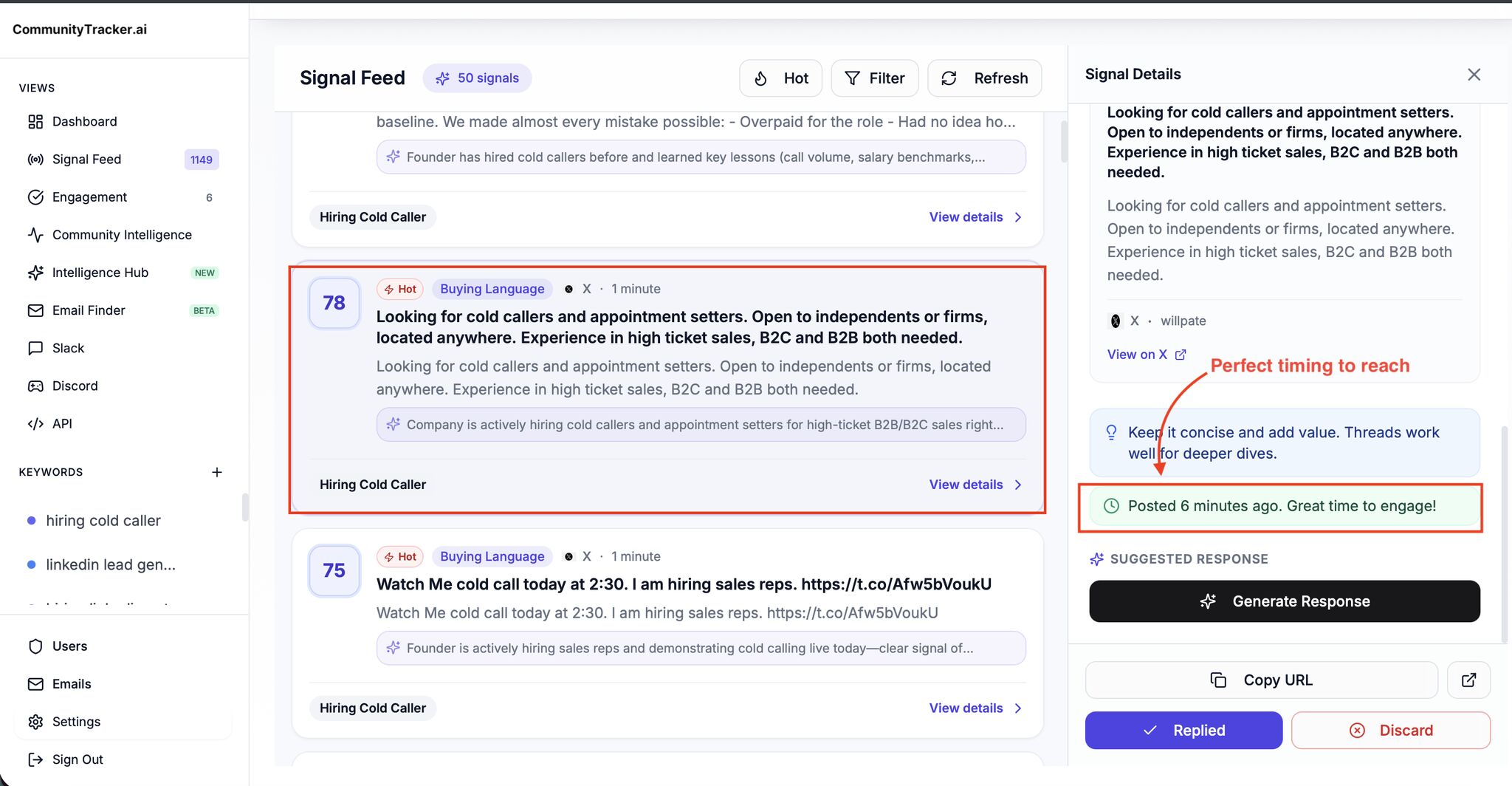
Its product positioning centers on high-intent buyer signals, competitor share of voice, Slack or email alerts, AI summaries, team workflows, and recommended next steps rather than simple mention collection.
Use it when:
Competitor conversations happen outside tagged social mentions.
Your team needs intent filtering, not another raw mention feed.
Sales and product marketing need alerts routed to Slack or workflows.
Share of voice across communities matters more than profile-only analytics.
You want the next move attached to the signal.
Do not use CommunityTracker as your only system if your main need is publishing, scheduling, paid social reporting, or deep Instagram/TikTok account analytics.
Traditional social media management and analytics suites are better for that workflow.
For CommunityTracker, the core use case is narrower and sharper: from signal discovery to GTM action.
If this is the workflow you need, start by mapping five competitors and the buyer-intent phrases that matter most, then use CommunityTracker to monitor those conversations across communities and route the best signals to Slack for sales, product marketing, or product.
FAQs#
How often should you track competitors on social media?#
Monitor high-intent alerts daily and run a deeper review weekly. Daily checks catch timing-sensitive threads. Weekly reviews keep the system from filling with noise.
What metrics matter most for competitor tracking?#
Track share of voice, engagement rate, top posts, sentiment, response time, content themes, and conversation quality. Follower growth helps with context, but it should not drive the whole workflow.
Can you track competitors without a tool?#
Yes, for a small watchlist. Follow competitor accounts, save platform searches, use Google Alerts, review Reddit and LinkedIn manually, and keep a weekly note. Use a tool when the signal volume gets too high or when routing matters.
What is the difference between competitor tracking and social listening?#
Competitor tracking focuses on named rivals, alternative searches, positioning, launches, and buyer reactions to competitors. Social listening is broader: it monitors conversations around brands, categories, customers, sentiment, trends, and market topics.
What should you do when a competitor wins attention?#
Do not react automatically. Identify why the post or conversation worked. Then choose the action: create content, update sales notes, clarify positioning, join the discussion, change campaign timing, or ignore it because the audience is not your buyer.
The next move#
Start with five competitors, three source groups, and 20 searches. Route only the signals that deserve action.
After two weeks, you should know which competitors are shaping the conversation, which communities carry real buyer intent, and which metrics are just dashboard decoration.
That is the point of competitor tracking.
Do not just show the post. Show the next move.